

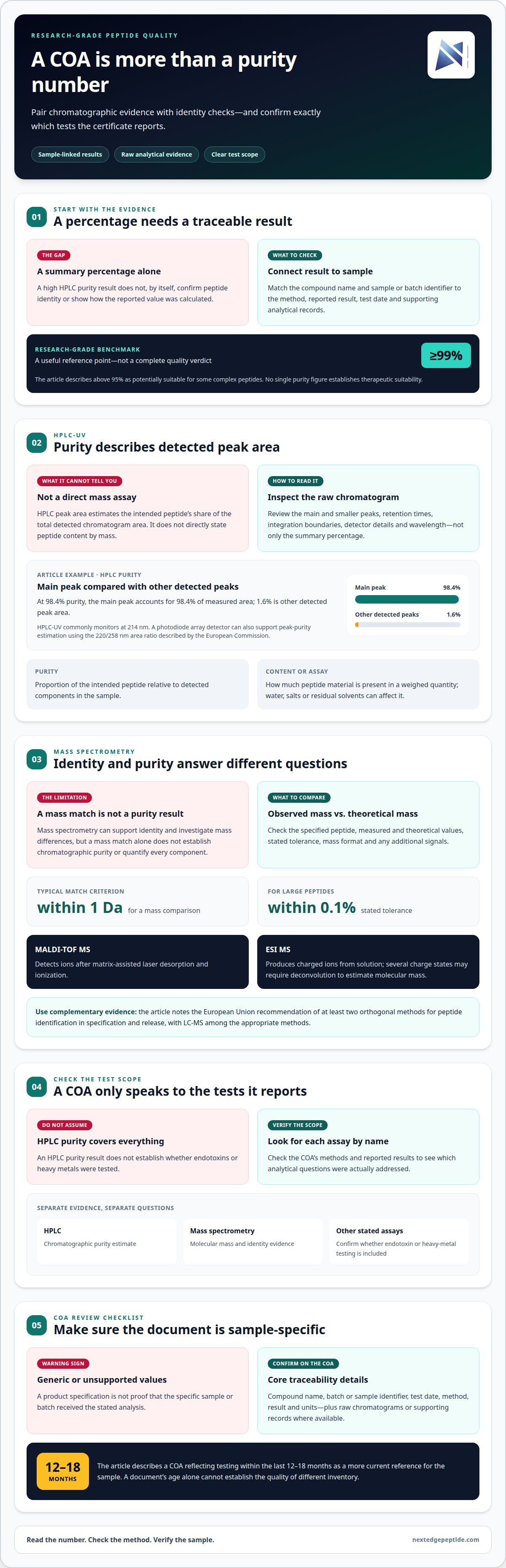
A high purity number is not a complete quality check. For research-grade peptides, use ≥99% HPLC purity as a benchmark, then assess molecular identity with mass spectrometry. To learn how to verify peptide purity, also confirm which tests the certificate of analysis (COA) reports: HPLC purity alone doesn’t establish whether endotoxins or heavy metals were tested.
A COA can look conclusive while leaving important questions unanswered. A result is useful only when it is tied to the peptide and batch in question, and when the underlying analytical data support the stated value.
This guide explains how to assess a COA, read raw HPLC chromatograms and interpret mass spectrometry results. You’ll learn what each method can establish, what it cannot, and how to distinguish a reported test result from an assumption about product quality.
Key Takeaways
- Read the COA alongside the raw HPLC chromatogram; the European Commission SOP describes estimating peak purity from the 220/258 nm area ratio when a photodiode array detector is available.
- Use mass spectrometry to assess molecular mass and possible impurities, since a high HPLC purity result alone doesn’t establish peptide identity.
- Separate HPLC purity results from endotoxin and heavy-metal testing when assessing what a COA covers.
- Use NextEdge Peptldes’ Peptide Calculator when peptide-related calculations are the next step after reviewing quality data.
Certificate of Analysis and raw HPLC data
A useful COA connects a reported result to a specific peptide sample and analytical method. Read the chromatogram alongside the stated HPLC purity: the percentage alone cannot answer every question about quality.
Reviewing Raw HPLC Data
Review the COA for the sample identifier, test method, detector details and reported result. Then examine the raw chromatogram, not just its summary percentage. Look for the main peak, smaller peaks, retention times and integration boundaries. These details show how the result was calculated and whether visible signals were included. A clear trace makes it easier to assess the reported peptide test independently.
Interpreting HPLC-UV Purity Results
Reversed-phase HPLC separates components before ultraviolet detection. In HPLC-UV purity testing, the method commonly monitors at 214 nm, where peptide bonds absorb. The hplc purity estimate compares the intended peptide’s peak area with the total area of detected chromatogram peaks. For example, 98.4% purity means the main peak accounts for 98.4% of measured area, leaving 1.6% as other detected peaks. This is a relative chromatographic estimate, not a direct mass assay. The European Commission describes estimating peak purity from the 220/258 nm area ratio when a photodiode array detector is available. Check the detector wavelength and integration method when assessing accuracy.
Distinguishing Purity from Peptide Content
Purity describes the proportion of the intended peptide relative to detected components in a sample. Content or assay addresses how much peptide material is present in a weighed quantity, which can be affected by water, salts or residual solvents. A sample can therefore have high chromatographic purity without the same percentage of peptide content by mass. Amino acid analysis can determine a peptide’s amino acid composition; HPLC peak area answers a different question.
Considering Testing Requirements
In Canada, an HPLC result describes composition; it does not establish a product’s regulatory status. Applicable requirements depend on intended use and product classification. For research-grade material, ≥99% is a common benchmark; above 95% may suit some complex peptides. No single purity figure alone establishes therapeutic suitability. Laboratory methods include RP-HPLC-UV for chromatographic purity and mass spectrometry for molecular mass. The sample amount and storage conditions depend on the method, sample form and stability. These details should be set by the testing protocol, since insufficient material or unsuitable storage can affect analysis.
Mass spectrometry for molecular mass and impurities
Mass spectrometry adds a molecular identity check to peptide analysis. It measures mass-to-charge ratios, then determines molecular mass from the detected ions. For identity confirmation, compare the observed mass with the peptide’s theoretical mass. A difference within 1 Da is a typical match criterion; for large peptides, the stated tolerance is within 0.1%. The applicable comparison depends on peptide size.
Common methods include MALDI-TOF MS and electrospray ionization mass spectrometry (ESI MS). MALDI-TOF MS detects ions after matrix-assisted laser desorption and ionization. ESI MS produces charged ions from a solution. Since ESI can produce several charge states, the data may need deconvolution to estimate molecular mass. Check the method and reported mass format before interpreting the result.
Mass spectrometry can identify mass differences consistent with deletion or truncated sequences, incomplete deprotection, or byproducts from synthesis and final cleavage. These signals help investigate impurities, but a mass match alone doesn’t establish chromatographic purity or quantify every component. A peptide could be 99.5% pure and still be the wrong peptide. The purity result and the identity result answer different questions.
How is peptide identity confirmed using mass spectrometry? The observed molecular mass is compared with the theoretical mass, and the analytical result is assessed alongside another method. The European Union recommends at least two orthogonal methods for peptide identification in specification and release, with LC-MS among the appropriate methods. Orthogonal methods provide evidence through different analytical principles, strengthening confirmation and consistency.
When interpreting results, check that the report connects the measured mass to the specified peptide and method. Note the observed and theoretical values, any stated mass tolerance, and whether the data show additional signals. For research peptide results, distinguish identity verification from impurity profiling. Mass spectrometry and chromatography provide complementary evidence; neither should be treated as a substitute for the other.
What a certificate of analysis should contain
A useful certificate of analysis (COA) connects a specific peptide sample with its test results. Review the sample identity, test date, methods and analytical scope before relying on its conclusions.
Reading a Certificate of Analysis
Start with the compound name and batch or sample identifier. Confirm that the reported result refers to that material, not a generic product specification. The COA should identify the method, test date, result and units. A COA reflecting testing within the last 12-18 months provides a more current reference for the sample. A document dated 2022 cannot establish the quality of inventory sold in 2026. Check whether raw chromatograms or supporting analytical records accompany the summary.
Including Amino Acid Analysis
Amino acid analysis can determine the amino acid composition of a peptide or protein product, providing information that complements a chromatographic purity result. Look for the reported analysis and its link to the named compound and sample. A COA should distinguish this result from other assays rather than treating all values as interchangeable. Composition data and an HPLC purity percentage, for example, answer different analytical questions.
Assess analytical services by matching the method to the question. HPLC reports chromatographic composition, while mass spectrometry assesses molecular mass. Amino acid analysis addresses composition. The laboratory’s report should identify which method produced each result and which sample it covered. Treat a stated purity value as a result, not a guarantee of identity or of tests outside the reported scope. Samples below 98% HPLC purity are generally considered substandard for research applications.
How much does peptide purity testing cost in Canada? There is no single price for every test panel. Cost depends on the compounds, number of samples, analytical methods and whether separate endotoxin or heavy-metal testing is included.
Check the scope carefully. An HPLC purity result does not report endotoxin or heavy-metal levels. Those require separate tests and results on the COA. A panel intended to assess these contaminants should identify the relevant test and its finding, rather than imply coverage through a general purity figure.
Peptide certificate verification
Use a short, repeatable workflow to assess whether a certificate supports a research peptide’s quality claim. A quick review can reveal mismatches between the document, sample and reported tests. Start with traceability, then assess the evidence and its scope.
Match the certificate’s compound name and batch identifier to the material it describes. Confirm that the analytical report uses the same identifiers. Without a clear link to the sample, a certificate cannot establish that its results apply to a particular batch. Check that the document names the test method, reports a result and gives a test date.
- Confirm the certificate and raw data refer to the same sample.
- Check that each result names its method and analytical scope.
- Separate reported tests from assumptions about untested contaminants.
Next, assess whether the evidence answers the quality question. HPLC data address chromatographic purity; mass spectrometry supports molecular-mass assessment. Neither result alone documents endotoxin or heavy-metal testing. Look for separate results when those tests matter to the research protocol. A general purity statement cannot replace specific analytical findings.
Dates matter. A COA from 2022 does not establish the quality of inventory being sold in 2026. A current document should connect its results to the relevant sample or batch, rather than relying on an older certificate for later inventory. Compare the stated test date with the batch information and supporting records.
Finally, check for consistency across the certificate, chromatogram and mass-spectrometry report. Differences in compound names, batch identifiers or reported methods need clarification before treating the records as one evidence package. Keep the conclusion specific: the certificate supports only the sample, methods and results it identifies. This workflow shows how to verify peptide purity without mistaking a polished summary for supporting laboratory data.
For research compounds, review the available options alongside your analytical requirements. Explore research peptide options as the next step after assessing the documentation.
NextEdge Peptldes: Peptide Calculator
NextEdge Peptldes’ Peptide Calculator can support a research workflow that requires a peptide-related calculation. Use it alongside your documented quality review, not as a substitute for a certificate of analysis, HPLC results or mass spectrometry. A calculator supports calculation tasks; laboratory data provide evidence about sample purity and identity.
Use the Peptide Calculator after reviewing the analytical information and identifying a calculation needed for your research planning. Keep these decisions distinct: calculated values do not confirm a sample’s contents or establish its purity. This distinction helps keep a clear record of what comes from calculation and what comes from testing.
For questions about NextEdge Peptldes’ research offerings or Peptide Calculator, contact NextEdge Peptldes.
Make quality evidence part of your research plan
Build a consistent review process before selecting a research compound. Your approach to how to verify peptide purity can guide purchasing decisions and help keep analytical evidence connected to your research requirements. Treat product selection and laboratory results as separate parts of the process.
NextEdge Peptldes offers GLP-3 (Reta), BPC-157 + TB-500 Blend and GLP-2 (Tirz) for scientific research. Consider these offerings in relation to your research needs, and keep the supporting documentation central to your assessment.
If you have questions about research compounds or the documentation relevant to your evaluation, contact NextEdge Peptldes. A clear, evidence-led process is a practical foundation for confident research planning.
Frequently Asked Questions
What does the COA include, and does it cover endotoxins and heavy metals?
A COA reports only the tests and results it identifies. HPLC purity does not show whether endotoxins or heavy metals were measured. Look for separate test names, sample identifiers and findings for each contaminant. If those entries are absent, the document does not demonstrate that they were tested. Match every result to the same peptide sample and batch before treating the certificate as relevant.
What tests should I get?
Choose tests according to the question your research needs to answer. HPLC or UPLC can assess chromatographic purity, while mass spectrometry supports molecular-mass and identity assessment. Amino acid analysis provides composition data. If your protocol requires contaminant screening, specify endotoxin and heavy-metal testing separately. A clear testing plan links each requested result to an analytical method, so a single purity figure isn’t mistaken for a complete panel.
How does HPLC or UPLC measure peptide purity, and what are its limitations?
HPLC and UPLC separate sample components through a column, then detect signals as they leave it. The main peak’s area is compared with the total detected peak area to estimate chromatographic purity. The result depends on the method and signals detected. Components that co-elute may not appear as separate peaks, and a UV chromatogram alone doesn’t confirm the molecular identity of every signal.
How do I read a peptide certificate of analysis and verify its test results?
Start by matching the compound and batch identifiers across the COA and supporting reports. Then compare each stated result with the raw record for that method, such as the chromatogram or mass spectrum. Check that units and sample labels align. For example, a chromatogram labelled with a different batch identifier cannot substantiate the COA result for your batch.
What impurities and contaminants should be tested for in synthetic peptides?
Testing may need to cover synthesis-related impurities, including deletion or truncated sequences, incomplete deprotection, and byproducts from synthesis or final cleavage. Consider endotoxin and heavy-metal tests separately, according to the research protocol. Culturing medium, extraction and purification procedures can also contribute impurities. The test panel should name the analytes or impurity categories assessed, rather than rely on a broad “purity” claim.
How can I independently test peptide purity at a Canadian laboratory?
For research in Toronto, define the sample and questions first: chromatographic purity, molecular identity or specified contaminants. Provide a clearly identified sample to the laboratory and request a report that links results to its sample identifier and methods. Keep the report with the batch records. The method, sample-handling requirements and requested analytes determine the testing plan.


