

A “GLP-3 drops” label alone doesn’t establish that a product contains retatrutide. The term GLP-3 is informal: there is no GLP-3 receptor in the human body, and retatrutide acts on GLP-1, GIP and glucagon pathways. A GLP-3 Reta research peptide is therefore not identified by the name alone; retatrutide has been studied in clinical trials as a once-weekly subcutaneous injection.
It’s reasonable to want clarity when a product name sounds like a research compound but its form or claims differ. As of October 3, 2026, no regulatory approval had been reported by Lilly. This article explains what the GLP-3R name means, what side effects were reported in retatrutide trials, and how to interpret the FDA status from a Canadian reader’s perspective.
Key Takeaways
- A “drops” label alone doesn’t verify a compound’s identity. Learn how to separate product wording from evidence about what it contains.
- In the May 2026 TRIUMPH-1 report, nausea affected 42.4% of participants in the 12 mg retatrutide group, compared with 14.8% in the placebo group.
- Trial monitoring also recorded dose-related heart-rate changes and dysesthesia. Consider these findings alongside the remaining long-term safety questions.
- Understand how the informal GLP-3R name can shape product claims, and distinguish pathway terminology from a receptor name.
FDA approval status and anticipated application
As of October 3, 2026, Lilly had reported no regulatory approval for retatrutide. It therefore had no FDA-approved status in the United States then. Retatrutide also had no approved brand name. For Canadian readers, FDA status does not establish Canadian authorization or availability. Those are separate regulatory questions.
Retatrutide remains investigational in Phase 2 and Phase 3 clinical trials. Lilly developed it to activate GLP-1, GIP, and glucagon receptors. That triple action differs from tirzepatide, which targets GLP-1 and GIP receptors. The GLP-3 label is not an approval category. The New England Journal of Medicine reported a 2023 Phase 2 obesity trial involving 338 adults; publishing trial results does not itself grant FDA approval. An estimated availability window of July 2027 to January 2028 applies only if approval occurs. It is an estimate, not an authorization date.
Trials have explored doses from 1 mg to 12 mg. Clinical trials administer retatrutide once weekly by subcutaneous injection. Researchers typically titrate doses over several weeks to reduce gastrointestinal discomfort and assess tolerance. These schedules describe controlled trials, not personal-use instructions. Trial protocols also assess insulin response, appetite, and metabolic outcomes.
A research peptide is supplied for laboratory research, not human consumption. Calling retatrutide a research peptide does not make it an approved medicine. To assess identity and purity, look for evidence tied to the specific batch: compare the lot identifier, analytical methods, and date of the results. Mass spectrometry can help verify molecular identity, while chromatography can assess sample composition. A label or stated purity percentage alone cannot prove that a vial contains authentic retatrutide at the claimed purity.
Regulatory status and laboratory verification answer different questions. A test report can characterize a sample, but it does not establish FDA approval or Canadian authorization. Keep the trial evidence, regulatory status, and batch-specific analytical data distinct when interpreting product claims.
What GLP-3 side effects were reported?
Retatrutide trials have reported gastrointestinal effects alongside changes in weight and metabolic measures. Nausea was common, and researchers also recorded increases in heart rate and sensory symptoms.
Metabolic and Body-Composition Effects
Metabolic and body-composition effects describe changes in weight and related measures during treatment. They matter because obesity research examines more than appetite alone. In a 2023 Phase 2 trial, adults receiving 12 mg retatrutide lost an average of 24.2% of their starting weight after 48 weeks, according to The New England Journal of Medicine. Retatrutide is a receptor agonist affecting GLP-1, GIP, and glucagon pathways. Those hormone signals are studied for their metabolic effects, including blood-glucose regulation. Trial outcomes describe groups, not a predictable result for each person.
Appetite and Gastric-Emptying Effects
Appetite and gastric-emptying effects involve changes in hunger signals and the movement of food from the stomach. GLP-1 activity can slow gastric emptying; retatrutide was reported to slow it by 30-50%. This may help explain why appetite and meal-related sensations are monitored in clinical trials. The effect matters because delayed stomach emptying can influence gastrointestinal comfort. It should not be confused with proof that a product labelled “GLP-3” contains retatrutide or produces the same effects.
Reported Side Effects and Safety Risks
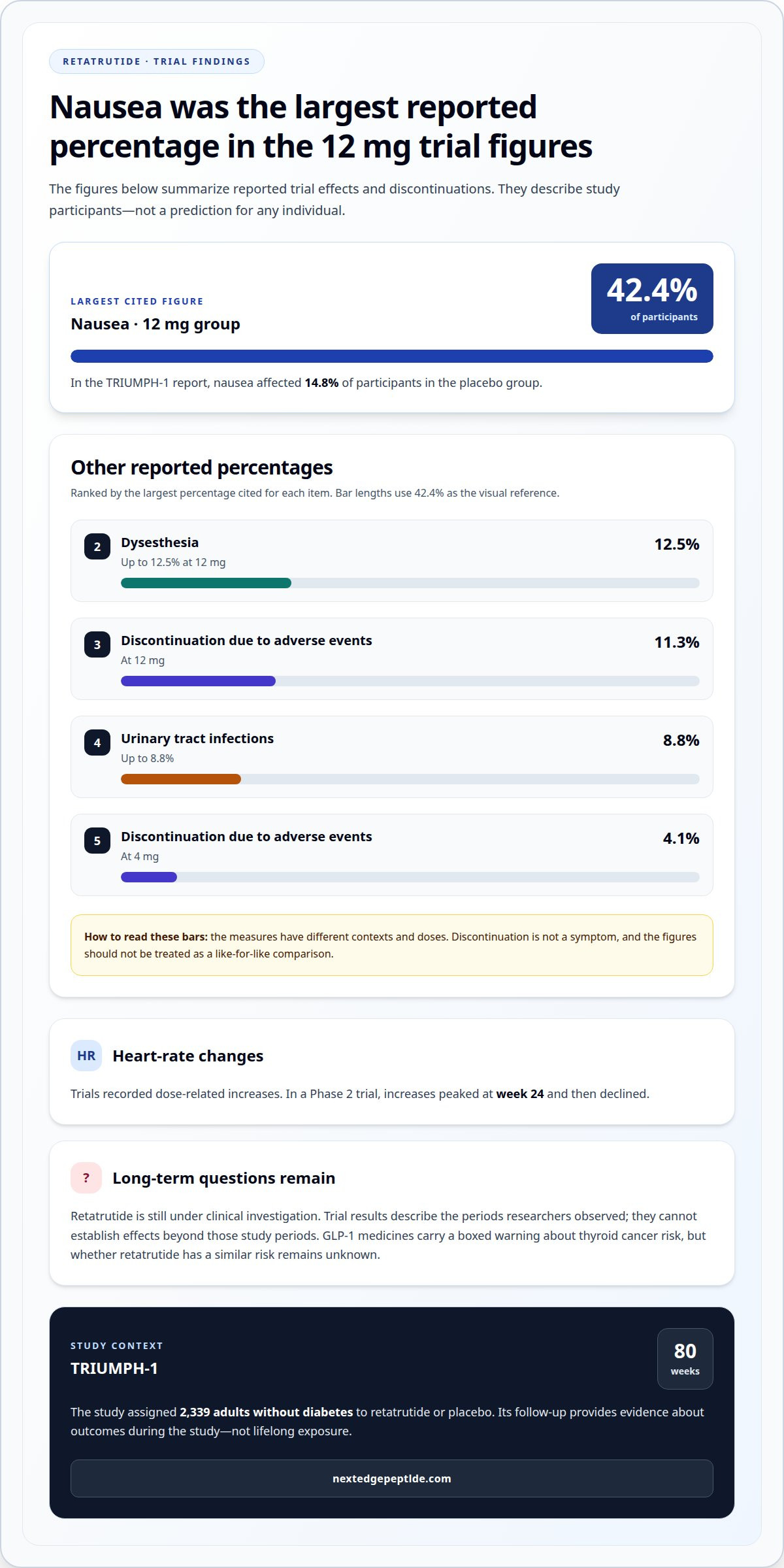
In the May 2026 TRIUMPH-1 report, nausea affected 42.4% of participants receiving 12 mg, versus 14.8% receiving placebo. Other reported trial effects included dose-related heart-rate increases, dysesthesia in up to 12.5% at 12 mg, and urinary tract infections in up to 8.8%. Discontinuation due to adverse events ranged from 4.1% at 4 mg to 11.3% at 12 mg. GLP-1 medicines carry a boxed warning about thyroid cancer risk; whether retatrutide has a similar risk remains unknown.
Buying an unapproved research peptide carries separate risks: a label cannot establish identity, purity, or suitability for human use. Research-labelled retatrutide is for laboratory research, not human consumption. A peptide calculator can support research calculations, but it cannot verify a product’s authenticity or clinical safety.
Clinical-trial side effects and long-term uncertainties
Retatrutide remains under clinical investigation, so trial monitoring helps researchers assess tolerability and identify unanswered safety questions. The duration and design of each study shape what its results can show.
Retatrutide trial costs vary with the protocol, site funding, and required monitoring, so there is no single cost for every study. Canadians may participate through a recruiting trial site if they meet its eligibility criteria, complete screening, and provide informed consent.
TRIUMPH-1 assigned 2,339 adults without diabetes to retatrutide or placebo and reported results over 80 weeks. That follow-up provides evidence about outcomes during the study period, not lifelong exposure. A triple agonist acts across GLP-1, GIP, and glucagon receptors, so researchers track several physiological responses rather than weight loss alone. The study’s duration and selected participants define how far its findings apply.
In a Phase 2 trial, dose-related heart-rate increases peaked at week 24 and then declined. This time course matters: a change during treatment may vary across the dosing period. Researchers also record adverse events and discontinuations to assess tolerability alongside weight outcomes. Across retatrutide trials, discontinuation due to adverse events ranged from 4.1% at 4 mg to 11.3% at 12 mg. These results describe trial participants, not every possible response.
Long-term uncertainties remain because retatrutide is still being studied. Trial evidence cannot establish effects beyond the periods researchers observed, and the highest dose studied does not resolve every safety question. Researchers assess whether changes persist, improve, or emerge with continued exposure. This distinction matters when interpreting trial findings on weight loss, metabolic measures, and safety signals. A reduction in one measured risk factor does not, by itself, establish long-term safety.
For Canadians, participation depends on a study’s recruitment status, location, eligibility criteria, and protocol. Screening determines whether an applicant meets the requirements, while informed consent explains the procedures and monitoring involved. Trial sites follow the study plan, which may include scheduled assessments and adverse-event reporting. Recruitment and participant costs are study-specific, as set by the protocol and site.
Meaning and informal use of the GLP-3R name
“GLP-3R” can look like the name of a receptor, because “R” often abbreviates receptor. However, there is no GLP-3 receptor in the human body. The label is informal, not a distinct biological target. Retatrutide is an investigational compound studied for activity across GLP-1, GIP, and glucagon pathways. Calling it a triple agonist describes those three targets, not a receptor called GLP-3R.
That distinction matters when interpreting a vial label, product description, or research summary. “GLP-3” may be shorthand for retatrutide, but the name alone does not establish molecular identity. Retatrutide is also known as LY3437943. Compare the name used in a study with the compound named in any batch-specific analytical documentation. A label that says “GLP-3R” cannot, by itself, show which hormone receptor pathways a sample affects.
Established drug names illustrate why precise target language helps. Semaglutide acts on the GLP-1 receptor, while tirzepatide targets GLP-1 and GIP receptors. Retatrutide’s studied profile adds glucagon activity to those two pathways. These distinctions describe pharmacology, not approval or suitability. The regulatory status of a compound is separate from the shorthand used to describe its target, and an informal “GLP-3” label does not signal a new approval category.
Read “GLP-3R” as a naming clue, not proof. Identify the actual compound, then distinguish a receptor name from a pathway description. For a GLP-3 Reta research peptide, that means checking whether the documentation identifies retatrutide or LY3437943 and whether the claimed target profile matches the triple-pathway description. Interpretation remains dependent on the specific wording and evidence; receptor shorthand cannot replace compound identification or regulatory information.
NextEdge Peptldes: GLP-3 (Reta)
NextEdge Peptldes offers GLP-3 (Reta) as a research compound for readers whose work concerns retatrutide. Its product name connects with the informal GLP-3 label, but a name alone does not establish a compound’s identity, purity, or regulatory status. The distinction matters: retatrutide remains investigational, and research peptides are supplied for laboratory research, not human consumption.
Use the information in this article to separate terminology from evidence, and assess research materials within their intended laboratory context. NextEdge Peptldes also offers BPC-157 + TB-500 Blend, GLP-2 (Tirz), and GLP-1 (Sema) for research. These offerings are not substitutes for approved medicines or medical care.
For information about the GLP-3 (Reta) research offering, contact NextEdge Peptldes.
Make your next research decision with clarity
Carry a clear distinction into your next research decision: a compound’s label, molecular identity, and regulatory status answer different questions. For a GLP-3 Reta research peptide, keep those questions separate when reviewing study materials or planning laboratory work. This approach helps prevent informal terminology from standing in for analytical evidence.
NextEdge Peptldes offers GLP-3 (Reta), BPC-157 + TB-500 Blend, and GLP-2 (Tirz) for research. Consider the offering that aligns with your research focus, and keep all compounds within their stated research context. Product selection does not replace clinical guidance or establish a compound’s suitability for human use.
For questions about research offerings, contact NextEdge Peptldes. Continue your work with precise terminology, careful documentation, and a clear research purpose.
Frequently Asked Questions
Are ‘GLP-3 drops’ the same as retatrutide?
Not necessarily. “GLP-3 drops” is a product label, not evidence that the contents are retatrutide. Retatrutide has been studied as a once-weekly subcutaneous injection, so a drop format differs from the clinical-trial administration route. For a Toronto researcher assessing a sample, compare its stated compound identity with batch-specific analytical results. A label alone cannot establish that the sample contains retatrutide.
How does GLP-3 work?
“GLP-3” commonly refers to retatrutide, which activates GLP-1, GIP, and glucagon pathways. These signals can affect appetite, blood glucose regulation, and energy balance. This is different from semaglutide, which targets GLP-1, and tirzepatide, which targets GLP-1 and GIP. The “GLP-3” shorthand does not describe a separate hormone or receptor in the body.
Is GLP-3R FDA Approved?
No GLP-3 receptor medication is FDA-approved under the name “GLP-3R.” As of October 3, 2026, Lilly had reported no regulatory approval for retatrutide, and it had no approved brand name. The FDA is a United States regulator; its status does not establish authorization in Canada. The name “GLP-3R” should not be read as proof of approval or a recognized treatment category.
What is GLP 3 (the GLP-3 peptide)?
“GLP-3 peptide” is informal wording commonly used for retatrutide, also known as LY3437943. It is an investigational compound, not a naturally occurring GLP-3 hormone. The name can cause confusion because it sounds like a receptor or hormone classification. Check the actual compound name and the context of any study or product documentation instead of relying on shorthand alone.
When will a “GLP-3” be available?
Retatrutide’s estimated availability window is July 2027 to January 2028 if it receives approval. That estimate is conditional, not a confirmed launch date. Retatrutide remains in clinical trials, and the “GLP-3” label itself does not establish that a product is an approved medicine. For Canadians, an estimated US approval timeline would not by itself establish Canadian authorization or availability.
Can it be combined with lifestyle strategies like diet and exercise?
Diet and physical activity can be considered alongside a person’s broader health plan, but retatrutide remains investigational. Trial findings do not establish how every lifestyle approach interacts with it. Separate research evidence from personal treatment decisions, and don’t treat a product labelled “GLP-3” as an approved medication. In Toronto, a health professional can assess relevant factors such as current medicines, health conditions, and treatment goals.


