

Research-grade tirzepatide is not an approved medicine. The GLP-2 Tirz research peptide is intended for in-vitro laboratory research, not human or veterinary consumption. As of 2026, tirzepatide in research-grade form is not approved for human or veterinary use.
It’s understandable to connect “Tirz” with tirzepatide medicines, but the research-grade compound and an approved prescription product are not interchangeable. In the United States, tirzepatide received FDA approval on May 13, 2022, and Zepbound was approved for chronic weight management in November 2023. Those approvals apply to specific medicines and uses, not research-grade material.
This article explains how tirzepatide relates to GLP-1 and GIP receptors, how it compares with semaglutide, and which gastrointestinal side effects are commonly discussed. It also separates U.S. FDA approval from Canadian status and clarifies why compounded products are a distinct regulatory issue.
Key Takeaways
- Distinguish tirzepatide’s GLP-1 and GIP receptor activity from the GLP-2 label, which does not describe its receptor action.
- Compare tirzepatide and semaglutide using the clinical trial populations, study duration and outcomes, not a single headline result.
- Recognize gastrointestinal effects such as nausea, diarrhoea, constipation and vomiting, and understand why gradual fibre intake may matter.
- Separate approved prescription medicines from compounded products and research-grade material when assessing Canadian use and regulatory status.
Comparison with semaglutide and other weight-loss drugs
Tirzepatide acts on GLP-1 and GIP receptors, while semaglutide acts on GLP-1 receptors. Clinical results depend on the population, dose and trial design, so percentages from separate studies are not direct head-to-head comparisons.
In SURMOUNT-1, 2,539 participants without diabetes were followed for 72 weeks. Mean weight reduction was 16.0% with tirzepatide 5 mg, 21.4% with 10 mg and 22.5% with 15 mg. In SURMOUNT-2, adults with obesity and type 2 diabetes had weight reductions of 12.8%–14.7% over 72 weeks. SURPASS-1 found HbA1c reductions of 1.87%–2.07% with tirzepatide monotherapy, compared with 0.04% for placebo.
SURMOUNT-5 directly compared tirzepatide with semaglutide in 751 participants. Other clinical-study results include 14.9% weight loss with semaglutide, but different trial conditions affect interpretation. Setmelanotide is another medicine, associated with 5.2% weight loss in patients aged 12 years and older with Bardet–Biedl syndrome.
Weight regain after treatment stops
Weight regain means recovering some lost weight after discontinuing treatment. In SURMOUNT-4, participants regained approximately two-thirds of their weight loss within one year of stopping tirzepatide. This matters because appetite and weight regulation can change after treatment ends; trial results during treatment don’t describe what happens after discontinuation.
Lean-mass effects also matter during weight reduction. In a three-week study of MC4R-knockout mice, all three tested GLP-1 analogues reduced lean mass, with no significant differences in muscle-mass change. These animal findings don’t establish effects in people, but show why total weight change alone is an incomplete measure.
Costs and legitimate alternatives in Canada
There is no appropriate treatment price for research-grade material because it is not a medicine for human use. Prescription medicines, including semaglutide or tirzepatide when prescribed for an applicable indication, are legitimate medical alternatives. A Canadian prescriber can assess suitability, clinical goals and access through the appropriate medical pathway.
Common gastrointestinal side effects
Tirzepatide is a dual agonist that activates GLP-1 and GIP receptor signalling. These hormone pathways influence appetite, digestion and energy regulation. Gastrointestinal tolerability is therefore a key part of understanding its effects, alongside weight and blood glucose outcomes.
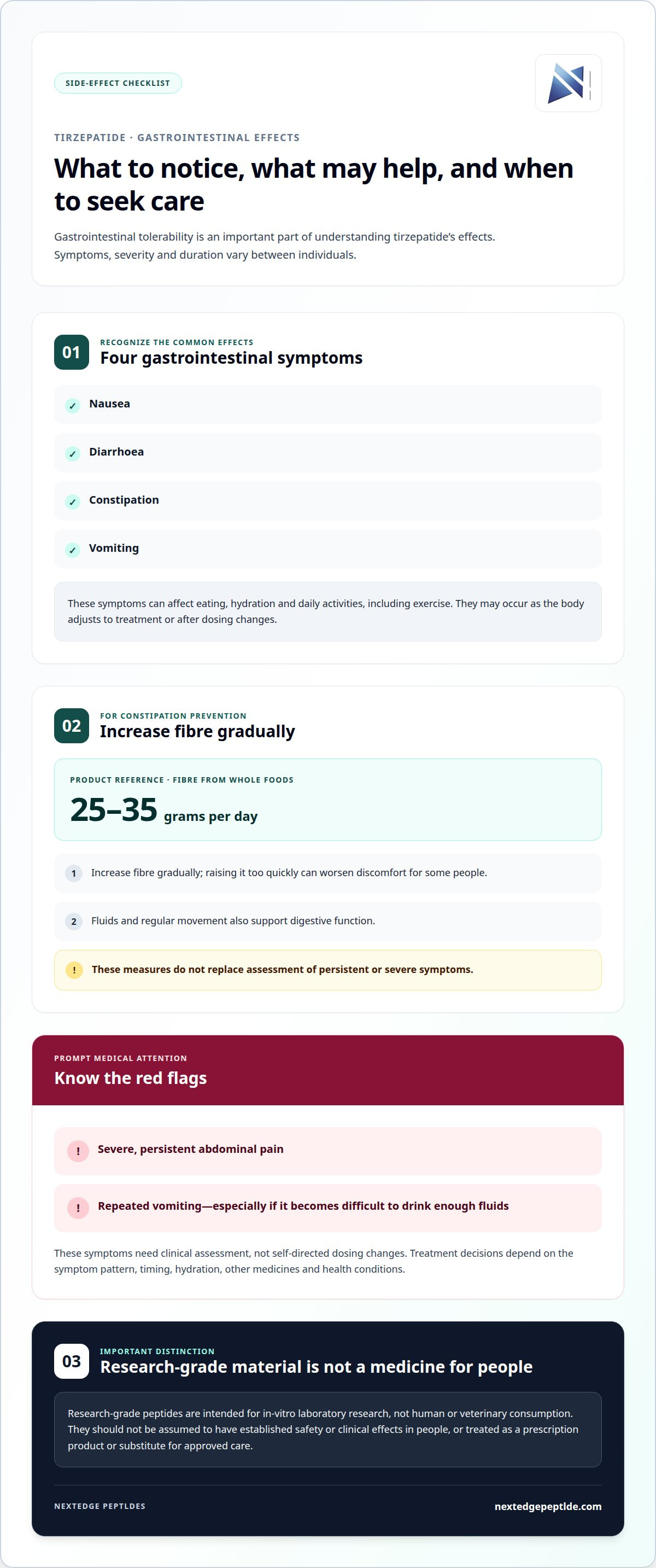
Common gastrointestinal effects associated with tirzepatide include nausea, diarrhoea, constipation and vomiting. These symptoms can affect eating, hydration and daily activities, including exercise. They may occur as the body adjusts to treatment or after dosing changes. Severity and duration vary between individuals, so trial averages cannot predict one person’s experience.
For constipation prevention, the product reference recommends gradually increasing fibre from whole foods to 25-35 grams per day. A gradual change matters: increasing fibre too quickly can worsen discomfort for some people. Fluids and regular movement also support digestive function, but they don’t replace assessment of persistent or severe symptoms.
Seek prompt medical attention for severe, persistent abdominal pain or repeated vomiting, especially if it becomes difficult to drink enough fluids. These symptoms need clinical assessment, not self-directed dosing changes. Treatment decisions depend on the symptom pattern, timing, hydration, other medicines and health conditions.
Research-grade peptides have a different risk profile. They are intended for in-vitro laboratory research, not human or veterinary consumption. Research-grade material should not be assumed to have established safety or clinical effects in people. Identity, handling and exposure can also affect research results, so this material must not be treated as a prescription product or a substitute for approved care.
For laboratory work, keep calculations separate from medical dosing decisions. A peptide calculator can support research calculations, but it cannot establish human safety or determine a treatment dose. Interpret gastrointestinal findings in the context of the study model, dose conditions and observed outcomes, not as evidence that an unapproved peptide is suitable for people.
FDA-approved indications and compounded products
Tirzepatide activates GLP-1 and GIP receptors, affecting pathways involved in insulin secretion, glucose regulation and metabolism. It is a receptor agonist, not a glucagon product; its receptor targets and actions differ from those of research-grade material marketed under abbreviated labels.
In the United States, tirzepatide received FDA approval on May 13, 2022. The FDA approved Zepbound for chronic weight management in November 2023. These dates describe U.S. approvals for specific medicines and indications. They don’t make every tirzepatide preparation, including compounded or research-grade products, an FDA-approved medicine.
Compounded products are distinct from approved, manufacturer-produced medicines. A U.S. supplier’s statements about not operating under sections 503A or 503B refer to U.S. facility classifications. Those terms don’t establish Canadian authorization or determine whether a product can be sold or imported in Canada.
In Canada, the legality of selling or importing a research peptide depends on its classification, intended use and applicable requirements. A “research use” label alone does not establish authorization for human consumption. Do not treat research material as a prescription treatment.
To assess authenticity and safety for laboratory work, examine batch-specific records for identity, purity, quantity and analytical methods. Chromatographic and mass-spectrometric results can provide different evidence about composition. A generic certificate without a matching batch identifier offers less traceability. No single document establishes suitability for human use.
Keep the distinction clear at the tissue level: approved medicines have defined indications, while research compounds are evaluated under laboratory conditions. GLP-1 and GIP signalling can affect insulin and glucose pathways, but those mechanisms don’t establish a product’s clinical status. For research calculations, use a peptide calculator only for laboratory work, not to convert a research quantity into human dosing.
Is GLP-2 Tirz approved by Health Canada for human use?
No. As of 2026, research-grade tirzepatide sourced outside pharmaceutical channels is a research compound, not approved for human or veterinary use. A GLP-2 Tirz research peptide label describes research material, not an authorized human medicine.
This distinction is about product status, not just the molecule’s name. Tirzepatide is a dual agonist of the GLP-1 and GIP receptors. The “GLP-2” label does not mean it acts on the GLP-2 receptor. Pharmaceutical medicines and research-grade material may refer to the same active molecule, but their regulatory status and intended use differ.
U.S. FDA approval dates don’t establish Health Canada approval. Tirzepatide received U.S. FDA approval on May 13, 2022, and Zepbound was approved there for chronic weight management in November 2023. Those decisions apply to specific products and indications in the United States. They do not authorize research-grade material for human use in Canada.
“For research use only” has a clear practical implication: the material is intended for in-vitro laboratory research, not human or veterinary consumption. A product label, certificate of analysis or online description cannot change that boundary. An analytical result also does not establish clinical safety, an approved indication or a suitable human dose.
For laboratory work, keep product identity, intended use and analytical documentation distinct. A certificate should identify the relevant batch and report what was tested, such as identity and purity. These records support research traceability; they do not constitute Health Canada authorization or evidence of human safety.
Keep the distinction clear when interpreting data: laboratory findings about tirzepatide cannot be translated directly into treatment decisions. Do not use research-grade material for self-treatment. For research context, review research-use product information and keep its stated laboratory purpose separate from human medicine.
NextEdge Peptldes: GLP-2 (Tirz)
NextEdge Peptldes offers GLP-2 (Tirz) for in-vitro laboratory research, not human or veterinary use. It is a research compound, not a prescription medicine or a substitute for medical care.
The product is supplied in a 10 mg vial. Store sealed material at −20 °C; refrigerate reconstituted material at 2–8 °C and use it within 28 days. These handling details support consistent research procedures, but don’t establish clinical safety or Health Canada approval.
For laboratory projects involving tirzepatide, align the intended research application, handling conditions and documentation. A Peptide Calculator can support research calculations, but it does not determine human dosing or suitability for treatment.
Contact NextEdge Peptldes to discuss GLP-2 (Tirz) for your laboratory research needs.
Set a clear direction for your next research project
Move from general interest to a defined research question. Before selecting a compound, specify the model, controls, measurement methods and intended readouts. This framework helps distinguish observed outcomes from assumptions and keeps laboratory material separate from decisions about human care.
Treat the GLP-2 Tirz research peptide as research material, not as a medicine or a basis for self-treatment. For a broader laboratory portfolio, NextEdge Peptldes also offers GLP-3 (Reta) and BPC-157 + TB-500 Blend. Select compounds according to the research question, not a clinical claim or expected outcome.
When you’re ready to discuss research-use offerings, contact NextEdge Peptldes with your questions. A clear project scope is a practical starting point for a focused conversation. Keep your research objectives precise, and proceed with confidence in the boundaries of your study.
Frequently Asked Questions
What is GLP-2 Tirz research peptide?
It is research-grade tirzepatide identified by the shorthand “Tirz.” The name can confuse two distinct terms: tirzepatide activates GLP-1 and GIP receptors, not the GLP-2 receptor. For a Toronto laboratory project, treat the label as a product identifier, then interpret findings according to the study design and experimental model. It does not establish suitability for human use.
Is GLP-2 Tirz a real peptide or a marketing name for tirzepatide?
It refers to tirzepatide, while “GLP-2 Tirz” is a label rather than the molecule’s formal name. Tirzepatide is a peptide composed of a 39-residue chain, with a listed molecular weight of 4813.5 g/mol. The “GLP-2” wording can wrongly suggest GLP-2 receptor activity. Molecular identity and receptor activity are separate properties, so interpret the name precisely.
What are the ingredients and claimed effects of GLP-2 Tirz?
The named research compound is tirzepatide; the label alone does not identify additional ingredients or establish a formulation’s full composition. Pharmaceutical tirzepatide has effects on appetite, body weight and glucose regulation through GLP-1 and GIP receptor activity. Those clinical effects cannot be assumed for research-grade material or treated as evidence of human safety. In laboratory interpretation, separate molecular composition from a seller’s claims.
What clinical research exists on tirzepatide and GLP-2?
Clinical trials such as SURMOUNT-1 and SURPASS-1 investigated tirzepatide, not a GLP-2 receptor treatment. Their findings concern tirzepatide’s GLP-1 and GIP receptor activity in defined study populations. The “GLP-2 Tirz” label does not mean those trials tested GLP-2 receptor activation. Keep the molecule, receptor target and trial population aligned when interpreting published results or planning laboratory comparisons.


