

A 10 mg vial is a quantity of compound, not a human dose. A GLP-2 Tirz peptide 10 mg vial contains tirzepatide labelled for research use; sealed lyophilized material is stored at −20 °C, while reconstituted material is refrigerated at 2-8 °C. These storage conditions do not make research material suitable for human use.
Before assessing a vial, it helps to understand what its label means, how reconstitution affects concentration, and how storage requirements change afterward. This guide explains those points, distinguishes product strength from dosing, and clarifies what a vial price represents, not the cost of medical treatment.
You’ll also find an overview of handling and administration terms, along with factors that affect price comparisons in Canada. The goal is practical clarity: understand the product unit and its research context before deciding whether it suits your needs.
Key Takeaways
- Separate vial strength from dose: the amount in a vial does not establish an appropriate amount for human use.
- Understand how reconstitution changes concentration, and why handling instructions depend on the material and its intended use.
- Learn the basic terminology for injection-site rotation and once-weekly administration without treating research material as a medication.
- Assess vial pricing by its unit and what the listed product represents, rather than assuming it covers medical care or administration.
10 Mg vial reconstitution and storage
Reconstitution turns a lyophilized vial into a liquid, but it does not establish a human dose. Storage requirements also differ for sealed powder and reconstituted material.
Vial reconstitution process
Reconstitution is the addition of a compatible diluent to lyophilized material. For concentration arithmetic, a 10 mg vial combined with 2 mL of bacteriostatic water yields 5 mg/mL. That example describes a calculated concentration, not instructions to prepare or inject research material. The volume withdrawn with a syringe depends on the intended dose and final concentration; a concentration alone cannot determine either.
Do not treat this calculation as medication guidance for weight management, glucose control, or treatment. Tirzepatide labelled for research use is not interchangeable with a prescribed medication. Clinical trials involving tirzepatide do not establish a safe preparation method for a research vial. Follow product-specific handling information for research procedures, and do not infer sterility or suitability for human use from the word “reconstituted.”
Storage and disposal practices
Storage is the temperature-controlled holding of material before and after reconstitution. Sealed lyophilized GLP-2/Tirz is stored at −20 °C; reconstituted material is refrigerated at 2-8 °C. Reconstituted material is advised to be used within 30 days. These timeframes are not interchangeable with instructions for a different tirzepatide medication or formulation.
Keep the vial labelled and separate from food, and avoid temperature changes during handling. Discard remaining material when its applicable use timeframe ends; do not extend use based on appearance. Place used syringes in an appropriate sharps container, not household recycling. Follow the product’s disposal directions and local arrangements for both liquid and sharps.
For weight loss and diabetes, tirzepatide and semaglutide are different medications, and results depend on the treatment and patient group. The clinical-trial figures provided do not offer a direct comparison, so they cannot show which is more effective for an individual.
In Canada, distinguish a pharmacy from a peptide research seller: a product page alone does not establish pharmacy status. Pharmacy legitimacy is assessed through the relevant provincial or territorial licensing authority. A research-use label does not make a product a medication.
People considering prescribed tirzepatide need an assessment of their medical history, allergies, and current medications. Insulin and other glucose-lowering drugs matter because combined treatment can affect blood glucose and hypoglycemia risk. A prescriber or pharmacist evaluates these factors against the medication’s prescribing information.
Injection technique and site rotation
A subcutaneous injection places medication into the tissue beneath the skin. This describes a route of administration, not permission to inject research-labelled material. A vial’s concentration does not establish an appropriate dose, injection volume, or safety for human use. For prescribed tirzepatide, follow the approved instructions and training for that medication. Do not apply those directions to a research peptide.
An injection site is the specific area selected for an injection. For prescribed treatment, site choice and technique depend on the medication’s instructions. Rotate the site weekly rather than repeatedly using the same spot to reduce the risk of lipodystrophy, a change in fatty-tissue distribution. A rotation plan should identify each selected area and record the date. Do not inject into irritated or damaged skin.
Temperature and handling matter at the point of administration, too. Prepare medication according to its own label, not a general protocol for insulin or another injectable. Check the instructions for storage conditions and preparation steps before use. If the product’s appearance or handling differs from its directions, stop and seek guidance from a pharmacist or prescriber. A clear-looking solution does not establish suitability.
Weight management and blood sugar treatment are clinical uses, not outcomes that can be inferred from an injection technique. Tirzepatide is designed for once-weekly use in the supplied treatment information, but the schedule does not determine a person’s dose or suitability. Research material is not a substitute for an approved medication or individualized care. For research calculations, use the Peptide Calculator to organize concentration arithmetic; it doesn’t determine a human dose or make a product suitable for injection.
Timing and administration
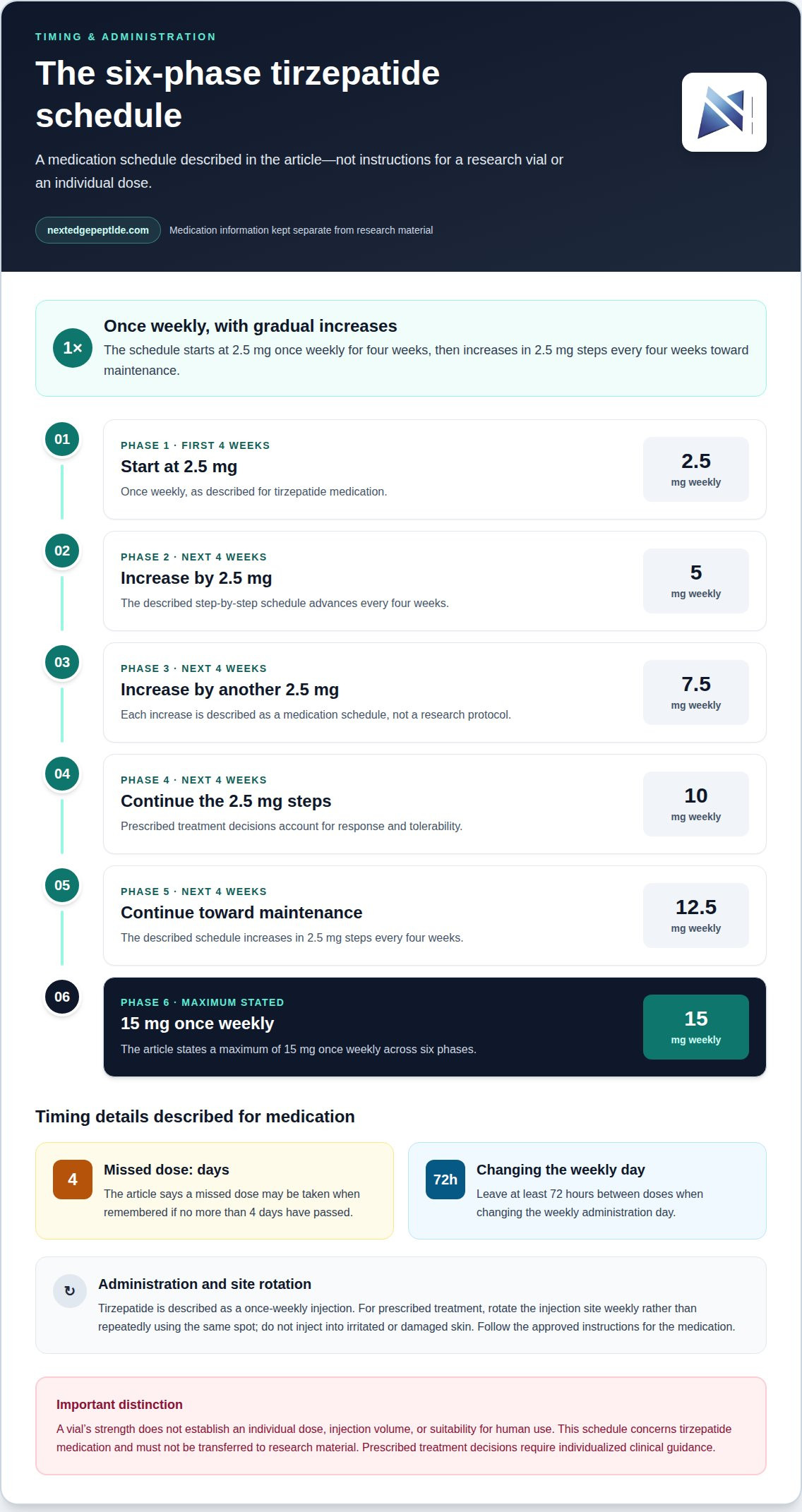
Timing is the planned interval between prescribed doses. Tirzepatide is designed for once-weekly use, but that schedule applies to medication, not research material. A vial’s strength does not establish an individual dose. Clinical-trial schedules are not personal dosing instructions. Keep product identity, intended use, and administration directions distinct.
Titration is a gradual change in dose over time. The schedule described for tirzepatide starts at 2.5 mg once weekly for four weeks, then increases in 2.5 mg steps every four weeks toward maintenance. The stated maximum is 15 mg once weekly across six phases. This is a medication schedule, not a protocol for a research peptide. Prescribed treatment decisions account for response and tolerability.
A missed dose is a scheduled administration that was not taken on time. It may be taken when remembered if no more than 4 days have passed. When changing the weekly administration day, leave at least 72 hours between doses. These timing rules concern tirzepatide medication and shouldn’t be transferred to another product or used to plan research injections.
Administration means giving a product by its intended route and schedule. Tirzepatide is described as a once-weekly injection; that instruction does not imply an oral route. Appetite, blood glucose levels, and side effects are clinical considerations during treatment, not reasons to change dosing independently. Glucagon is a distinct hormone, and mentioning it does not define a tirzepatide schedule. A prescriber evaluates medication use within a patient’s treatment plan.
The information here does not establish a human dosing schedule for research-labelled material. Do not turn a vial concentration into a weekly treatment plan or combine it with prescribed insulin or other medication on your own. Clinical-trial results describe a study group, not an individual response. Use prescribed tirzepatide only as directed, and keep research handling separate from patient treatment.
10 Mg vial pricing
Vial pricing is the amount charged for a specific product unit, not a measure of treatment value. For a GLP-2 Tirz peptide 10 mg vial, compare the stated vial strength and the number of units in the order. Those details clarify what the listed price covers without implying that it includes medication, clinical care, or administration.
Cost per unit means the order total divided by the number of vials. Use that calculation only when the order total and unit count are both available. A larger order can change the per-unit amount, so compare like quantities and the same vial strength. Don’t compare a 10 mg vial directly with a different format as if both contain equal amounts. Check that each listing uses the same unit basis.
Product format also affects how a price should be interpreted. A 10 mg label identifies the stated amount in the vial; it doesn’t identify a weekly dose or treatment duration. Reconstitution changes the concentration, not the vial’s total labelled amount. A price comparison for a GLP-2 Tirz peptide 10 mg product should keep those measures separate, especially when reviewing research material rather than prescribed medication.
Tirzepatide is a dual receptor agonist that acts on pathways involving glucose-dependent insulinotropic polypeptide and glucagon-like peptide-1. This pharmacology helps explain why prescribed tirzepatide is discussed in diabetes and weight-loss contexts, but it doesn’t establish the value or intended use of a research vial. Clinical outcomes and side effects, including nausea, are not pricing components or product guarantees.
Before comparing listings, identify the exact unit, vial strength, order quantity, and any clearly stated inclusions. Separate research compounds from approved medication and treatment costs. Weekly dosing schedules used for prescribed tirzepatide shouldn’t estimate how long a research vial will last. A transparent comparison of a GLP-2 Tirz peptide 10 mg vial depends on consistent units and stated terms, not assumptions about weight loss, clinical effects, or a hormone-related mechanism.
NextEdge Peptldes: GLP-2 (Tirz)
NextEdge Peptldes offers GLP-2 (Tirz) for scientific research, giving researchers a product option relevant to the vial formats discussed here. The Peptide Calculator can support concentration calculations when planning research handling; it does not determine a human dose or make research material suitable for treatment.
These offerings are for research material or a calculation tool, not prescriptions or clinical services. Keep vial strength, reconstitution arithmetic, storage conditions, and intended research use as separate considerations. This helps prevent mistaking a product format for an approved medication or a personal dosing plan.
For research-use questions about GLP-2 (Tirz) or the Peptide Calculator, contact NextEdge Peptldes.
Choose the Next Step for Your Research
Before selecting a GLP-2 Tirz peptide 10 mg vial, define the research purpose and the handling workflow it requires. Keep product format, intended use, and preparation records aligned. This makes the next decision more precise than choosing by vial size alone.
NextEdge Peptldes offers GLP-2 (Tirz), GLP-3 (Reta), and BPC-157 + TB-500 Blend for scientific research. These offerings are research compounds, not a substitute for prescribed medication or clinical care. If you’re assessing a research-use product, focus your questions on the specific compound and its relevant product information.
For product questions or help identifying the relevant research offering, contact NextEdge Peptldes about your research needs. A clear question is a practical starting point for your next step.
Frequently Asked Questions
What is GLP-2 (Tirzepatide)?
In this product context, “GLP-2 (Tirzepatide)” refers to tirzepatide, not native GLP-2. Tirzepatide is a 39-residue peptide that acts on GIP and GLP-1 receptor pathways. Native GLP-2 is a different 33-amino-acid peptide. The similar abbreviations can cause confusion, so use the full compound name when reviewing labels, research materials, or clinical information from providers like NextEdge Peptldes.
Can GLP-2 be combined or stacked with other peptides?
No human-use stacking protocol is established here for tirzepatide and other peptides. Combining research compounds does not establish compatibility, safety, or a useful outcome. For research, document each compound and keep study conditions distinct instead of assuming a blend or combination is appropriate. Do not use research-labelled peptides together as a personal treatment plan or substitute for prescribed medication.
GLP-2 (Tirzepatide) Cycle Length: How Long Should It Last?
A research vial does not define a human cycle length. Its contents and concentration cannot establish a personal schedule or treatment duration. Prescribed tirzepatide follows medication-specific directions, while research use requires a defined study protocol and purpose. In Toronto, keep research planning distinct from clinical treatment; do not translate a vial’s contents into weeks of personal use.
How Long Until I See the Results?
There is no fixed timeline for an individual to see a change. Some reports describe noticeable weight changes within the first few weeks for tirzepatide users, but that observation cannot predict an individual response. Trial outcomes describe groups under study conditions and cannot tell someone when their appetite, weight, or glucose levels may change.
Is GLP-2 legal to buy, and what does “research use only” mean?
“Research use only” identifies material intended for research, not human consumption or self-treatment. The label alone does not establish the legal status of a particular product or transaction in Canada. Online availability in Toronto does not prove authorization as a medication. Keep research purchasing separate from obtaining a prescribed drug, and do not use research-labelled material as treatment.
What are the most commonly reported side effects?
Nausea is relevant to discussions about prescribed tirzepatide, but the product facts here do not establish a ranked list of side-effect frequency. Do not apply findings about another peptide, such as teduglutide, to tirzepatide. For prescribed medication, consult its product information about potential adverse effects and discuss concerns with a pharmacist or prescriber.


